The Flow Field Mode: Steering Is the Whole Difference
Flow Field and its sibling read the same field and look nothing alike. The difference is one number: how hard a strand is steered toward the direction the field is pointing.
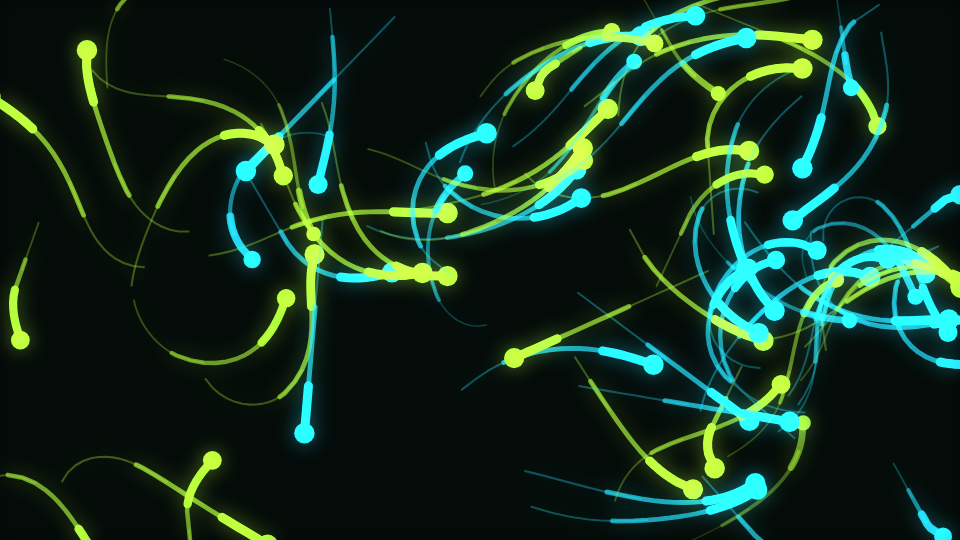
Flow Field is the mode in the Trails engine whose whole job is to make an invisible thing visible: dense particles reveal a deterministic curl-noise field. A vector field has no appearance of its own. You see it only because a large number of strands are obeying it at once, which makes this the one mode in the engine where the population and the steering are the same design decision.
Where a strand starts
Strands are not scattered by a random pair of coordinates. The frame is divided into a 4 by 3 grid of twelve cells, each strand is assigned a cell by its index, and it is then jittered inside that cell by a hash of its own index. That is stratified sampling, and the reason for it is that pure random placement clumps: run it a hundred times and you will reliably get an empty quarter and a crowded corner. A field with a hole in it cannot show you the field.
Initial headings come from the whole circle rather than from one direction, then lean toward the configured direction by a bounded fraction of the way. And a strand enters WITH its wake already seeded backwards along its heading, rather than growing one vertex per frame, so the trail length you set is correct from a strand's first frame instead of only once it has survived a second.
The one number that separates two modes
Both this mode and the engine's ribbon mode ask the Flow field control which field to read, get an angle back, and steer the strand toward it. The difference is the steering rate. This mode steers at 3 and the ribbon mode at 2.4, and the per-frame turn is that rate times the frame time times a factor that Turbulence and the onset burst both widen.
A higher rate means a strand converges onto the field's direction faster and holds it more tightly, so the currents read as sharp. A lower rate lets the strand keep more of its own momentum, so it reads as a ribbon drifting through the field rather than as a particle bound to it. Turning either one down far enough gives you the same picture from both.
Turning is shortest-path
The angle difference is wrapped into the range from minus half a turn to plus half a turn before it is applied, so a strand that needs to turn 10 degrees never takes the 350-degree route instead. Without that wrap you get an occasional strand pirouetting for no visible reason, which is the sort of artefact that looks deliberate and is not.
Which field, and what each one looks like
The Flow field dropdown is scoped to this mode and the ribbon mode only, and this one ships noise. That option samples a two-dimensional noise function that scrolls with time, so the currents wander and reorganise. The alternatives are structural rather than organic: a vortex returns the tangent of the angle to the centre, a radial field returns that angle itself, a gravity well points inward but goes tangential near the middle so nothing collapses to a point, and a shear field splits the frame into two opposed halves. Choosing "none" drops the steering rate from 3 to 0.4 and leaves the strand on its own course with only the turbulence wander.
Life, and what a beat does to it
Every strand carries a time to live between 2.5 and 8 seconds, staggered by a hash so the field never dies and respawns in lockstep, and its life drains every frame. Beats revive strands in rotating groups of four, topping the life back up rather than resetting it, so a quiet passage thins the field out and the next beat repopulates it. That is the engine's answer to "trails dissipate and the beat brings them back" written as mechanics rather than as a global opacity ramp.
The numbers it ships
This mode ships a Trail count of 80 against an engine default well below it, and a Trail length of 0.9, which is short. That pairing is the recipe: many strands, each carrying a brief wake. Long wakes at this population would overlap into a wash and the field would stop being legible. The number you set is a target, not a promise. It is scaled by the preview scale, by the canvas area relative to 1080p, and by a further reduction on machines reporting four or fewer cores, then capped. Export with capture quality on and the last two of those are switched off, so the exported frame is the count you asked for.
When to reach for it
Ambient, techno, drum and bass, and anything with continuous forward motion rather than discrete hits. It reads well behind text because the currents are horizontal-ish on average and the individual strands are thin. For the same engine tuned the other way, read The Ribbon Flow Mode, and for emission with a fall instead of a drift, The Fountain Burst Mode: An Arc That Is Culled, Never Clamped.
Open Flow Field in the gallery or start from the editor deep link.
Reviewed by the editorial team. Report a correction.
Keep reading
Was this page helpful?
Anonymous. Only this page’s address and your yes/no are recorded, and only if you allowed analytics cookies.
Ready to make your own?
Open the editor, drop in a track, and export a watermark-free video: free, no account.
Open the Editor