The Ribbon Flow Mode: Why a Ribbon Is Not a Thick Line
Ribbon Flow is the only mode in Trails drawn as a two-edged shape rather than a stroke, because a stroked line cannot change width along its length. Here is what that buys and what it costs.
Ribbon Flow is described in the catalogue as wide layered ribbons following a smooth curl field. Both halves of that sentence are load-bearing, and the first half is the one that changes how the mode is drawn.
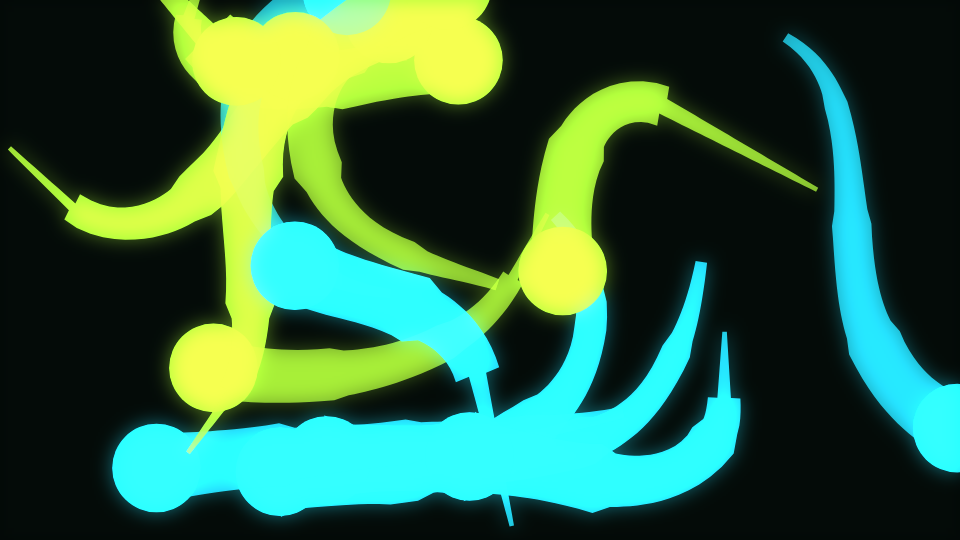
A stroked polyline has one width
Canvas strokes a path at a single line width. You can stroke the same path several times at different widths, which is what the other modes in this engine do to fake a taper across three segments, but within one stroke every point is the same thickness. A ribbon that is genuinely wide in the middle and narrow at both ends is not a stroke at all. It is a filled shape with two edges.
So this mode builds one. It walks the strand's history forward along one side and back along the other, offsetting each vertex along the perpendicular of the local direction, and fills the closed result. The half-width at each vertex combines a linear taper from tail to head with the band level that was recorded at that vertex, which is the payoff: the ribbon is a readout of what the strand heard, not just of where it went.
Why every vertex stores a level
Each strand's history buffer holds three numbers per vertex, not two. The third is the strand's own band level at the instant that point was recorded. Nothing else in the engine needs it, but without it a ribbon can only be tapered by position, which reads as decoration rather than as a trace.
The width cap is not arbitrary
This mode multiplies the Thickness control by twice what the stroked modes use, then multiplies again by the strand's energy and the beat pulse. It ships thickness at 12, which is high. Left unbounded, one strand at full scale covered close to a sixth of the frame height, which reads as a smear rather than as a trail.
The half-width is therefore capped against the frame box rather than against the control. The practical effect is that you can set Thickness for the look you want at rest and the loud passages stay legible, which is the same bargain the containment rule makes everywhere else in the catalogue.
The flow field, and why curl is the default
Flow field is scoped to exactly two modes in this engine, and this is one of them. The options are none, curl, vortex, noise and radial, and this mode ships curl. Curl is the curl of a scalar potential, which makes it divergence-free: particles never pile up in sinks or thin out in sources, so density stays even across the frame however long the field runs.
- Curl is the smooth wandering default. It is the only field here whose density is guaranteed stable over time.
- Vortex points every strand tangentially around the frame centre, so the field becomes a slow rotation.
- Radial points strands directly away from or toward the centre, which reads as an explosion rather than a current.
- Noise is a value-noise field that drifts with time. Busier than curl, and it can crowd.
- None drops the steering almost entirely, so a ribbon keeps the course it was born on and only turbulence bends it.
The field is evaluated in normalised frame coordinates, which means the pattern looks the same at every export resolution. The drift is part of the composition rather than a property of the canvas, and that is what lets a 1080p preview predict a 4K export.
The controls that matter here
Trail count is the population, and this mode ships it low at 14, because wide ribbons overlap fast. Trail length sets how many vertices each ribbon carries, and therefore how long the shape is. Trail decay holds the field between beats. Turbulence loosens the steering so a ribbon wanders off the field rather than tracking it exactly. Speed ships at 0.16, slower than the comet mode, because a wide shape moving fast is a wipe.
When to reach for it
House, downtempo, neo-soul, and anything with a legato top line. It is the mode in this engine that most reads as painted rather than drawn, and it sits well behind a logo because the ribbons naturally leave the centre alone when the field is curl. For the other end of the same engine, read The Comet Shower Mode: Four Edges, and Every Comet Its Own Course. Open this one at the template page or in the editor.
Reviewed by the editorial team. Report a correction.
Keep reading
Was this page helpful?
Anonymous. Only this page’s address and your yes/no are recorded, and only if you allowed analytics cookies.
Ready to make your own?
Open the editor, drop in a track, and export a watermark-free video: free, no account.
Open the Editor