The Ripple Blossom Mode: Interference Needs More Than One Ring
Ripple Blossom keeps several beat-born rings alive at once, which is the only way concentric waves can interfere. Here is the ring pool, the petal envelopes and the containment rule underneath both.
Ripple Blossom is the mode in the Bloom engine whose catalogue line is a promise about physics: concentric growth waves form petal interference patterns. Interference is the word that does the work there, and it is the reason this mode needed a pool rather than a variable.
One ring is not a wave pattern
The obvious way to draw a ripple is to make its radius a function of the current beat envelope. That version existed, and it produced exactly one ring, which appeared while the envelope was decaying and vanished when it finished. There was never more than one on screen, so the interference in the description was in the copy and absent from the render.
The fix is a small fixed pool of ring slots. On every latched beat the next slot in the pool is reset to age zero and given a strength from the current pulse. From then on each ring ages on its own clock, expanding and fading independently, and when its life runs out the slot frees itself. Six concurrent rings is enough for the crossings to read and few enough that the cost is a handful of strokes per frame.
You can hear the pool by changing tempo
On a slow track a ring has mostly faded before the next one is emitted, and the mode reads as single expanding circles. On a fast track three or four are alive at once and the crossings appear. That is the pool working, not a setting changing.
The petals underneath
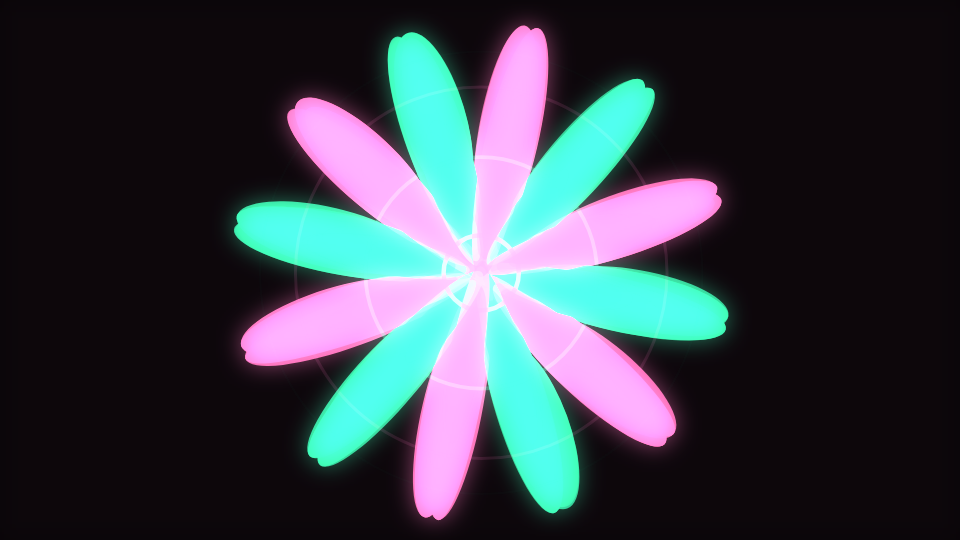
This mode shares the petal system with the engine's default mode, with one structural difference: it draws twice as many rings of petals. Each ring runs its own growth phase, offset by its index and nudged by the beat count, so rings bloom and decay out of step instead of the whole composition zooming as one object.
Individual petals are independent too. Each has its own decay envelope, and beats ignite them in round-robin groups, so the eye can follow the order around the flower rather than seeing every petal jump at once. The reach of a petal is set by its own slice of the spectrum, not by a shared level, which is what makes the silhouette change shape rather than change size.
Containment, and why the petals are not squashed
Bloom was the catalogue's worst measured offender for geometry leaving the frame, because one growth scalar multiplied a radius that nothing bounded. A petal is not a simple radius, though: it is offset along its ray, its ellipse sits further out again, and the ellipse extends its own half-width beyond that.
So the limit is applied to the outermost ink and then folded back as a single ratio on the whole petal. Every term is linear in the petal scale, so one ratio shrinks the shape in proportion and never distorts it. Clamping each term separately would have squashed petals into slivers at exactly the moments the music was loudest, which is the failure the safe zone exists to prevent.
The controls worth moving
- Symmetry is the petal count per ring. The mode ships 12, and it is the single biggest change to the silhouette.
- Spread widens the flower and also lengthens the per-petal decay, so high values read as softer as well as larger.
- Growth rate turns the whole arrangement slowly, with alternate rings counter-rotating.
- Lifecycle is the absolute duration of one growth cycle in seconds, while Speed scales how fast the clock runs through it. The two are not duplicates: one sets the length of the cycle, the other how quickly you move along it.
- Rotation is scoped to this mode and the default petal mode only, and it is added on top of the growth rate with the same alternating sign.
Bloom amount and Global glow are folded together into the opacity of every petal, so glow on this engine is a real term in the drawing rather than a post-process. The engine's published budget is 256 elements by default and 96 on mobile.
When to reach for it
Ambient, classical crossover, meditation and sleep content, and any release whose artwork is already organic. It is a centred composition, so it wants the title above or below rather than across it. Open Ripple Blossom or start from the editor, and read The Crystal Growth Mode: Structure That Accretes Instead of Breathing for the mode in the same engine that builds instead of breathing.
Reviewed by the editorial team. Report a correction.
Keep reading
Was this page helpful?
Anonymous. Only this page’s address and your yes/no are recorded, and only if you allowed analytics cookies.
Ready to make your own?
Open the editor, drop in a track, and export a watermark-free video: free, no account.
Open the Editor