The Ink Diffusion Mode: A Colony That Moves Every Fourth Beat
Ink Diffusion holds its arrangement for four beats and then moves the whole colony at once. Here is why that interval exists, and which of its shipped defaults does nothing at all.
Ink Diffusion is the softest thing in the Bloom engine: soft reaction-diffusion fronts spread through the canvas. It shares its draw branch with the engine's cellular mode, and the two of them differ by exactly two things, one of which is a single number.
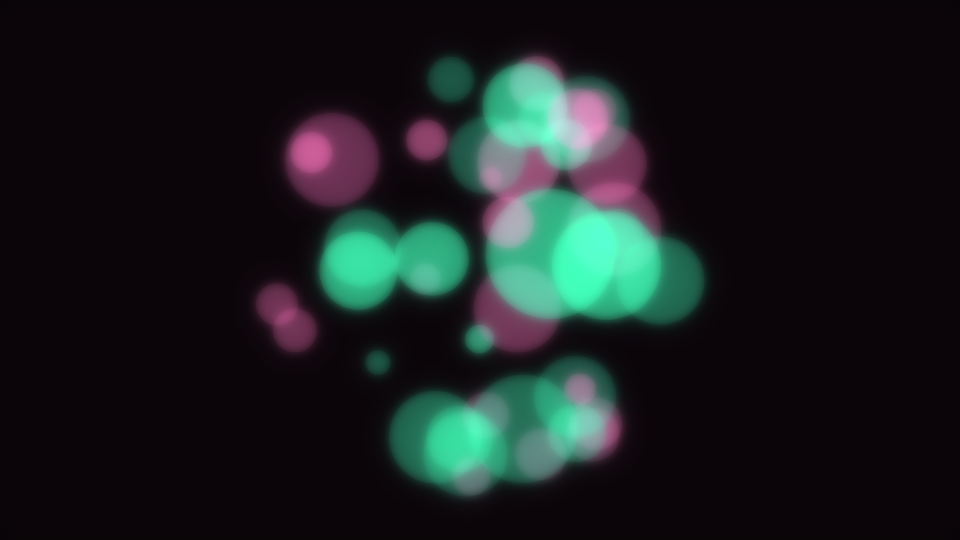
Where a cell sits, and when it moves
Each cell's angle and distance from the centre come from a hash of its own index, so a cell holds its place for as long as it exists. That is not how this branch always worked: it used to hash against a time-derived value, which meant the entire colony teleported to a new arrangement twice a second regardless of the music. The visible flicker that produced is the defect this design replaces.
What the hash is salted with now is the era: the beat count divided by four and floored. Every fourth beat the era advances, every cell draws a new angle and a new distance, and the colony re-arranges itself. Re-arranging on every beat reads as noise; holding for a bar and then shifting reads as growth. The distance is the square root of a hashed value rather than the value itself, which is the standard correction for sampling a disc evenly: without it, half the colony crowds the centre.
A shipped default that does nothing
This mode ships a value for the Spread control. That control is scoped to two other modes in this engine and does not appear in this mode's panel at all, and this branch never reads it. It is a number in the catalogue with no path to the canvas, and it is the clearest example in the engine of why a default is not evidence of an effect.
The one number that separates it from its sibling
Both modes draw the same discs at the same hashed positions with the same per-cell envelopes. The ink model paints them at a base alpha of 0.12; the cellular model paints them at 0.4. That is over three times the ink, and it is the difference between a structure you can pick individual cells out of and a stain you cannot. The second difference is the budget: the cellular model gets seven cells per seed where this one gets six.
Both of those are downstream of the Seeds control, which multiplies into the total, and of Cell size, which is scoped to these two modes only and scales every disc's radius around a reference value of 14.
Why the softness is not in this file
The mode ships a Blur of 4, and that is not applied by the branch that draws the discs. It is a full-frame post pass: once the frame is drawn, the engine blits the canvas onto itself through a blur filter and mixes 85% of the blurred copy with 15% of the sharp one. Doing it that way rather than per shape is the difference between about two milliseconds and about a hundred and fifty, because a per-primitive blur charges the filter once per disc.
Containment, counted from the edge of the ink
A cell's distance from the centre is soft-limited against the frame's contain radius MINUS that cell's own radius. Limiting the centre alone is not enough: a colony whose centres all sit exactly on the boundary still spills half of itself over it. The limit is a soft knee rather than a clamp, so a loud passage still reads as further out instead of flattening every cell onto the same ring.
When to reach for it
Ambient, neoclassical, downtempo, spoken word, and anything where the visual is a wash rather than a readout. It is one of the calmest of the 138 modes in the catalogue and it survives a vertical crop well, because its composition is a distribution around a centre rather than a wide horizontal arrangement. For the same engine building structure instead of dissolving it, read The Crystal Growth Mode.
Open Ink Diffusion in the gallery or go to the editor.
Reviewed by the editorial team. Report a correction.
Keep reading
Was this page helpful?
Anonymous. Only this page’s address and your yes/no are recorded, and only if you allowed analytics cookies.
Ready to make your own?
Open the editor, drop in a track, and export a watermark-free video: free, no account.
Open the Editor