The Orbiting Bars Mode: Bar Width Is the Circumference, Divided
Orbiting Bars never lets you make a solid disc by mistake, because it derives every bar's stroke width from the circumference and the count rather than from a width control.
Orbiting Bars is the Logo engine answering the most common brief it gets: a full equalizer ring orbiting the artwork. It reads as the familiar circular equalizer, and one arithmetic decision inside it is the reason it always reads that way regardless of what you set.
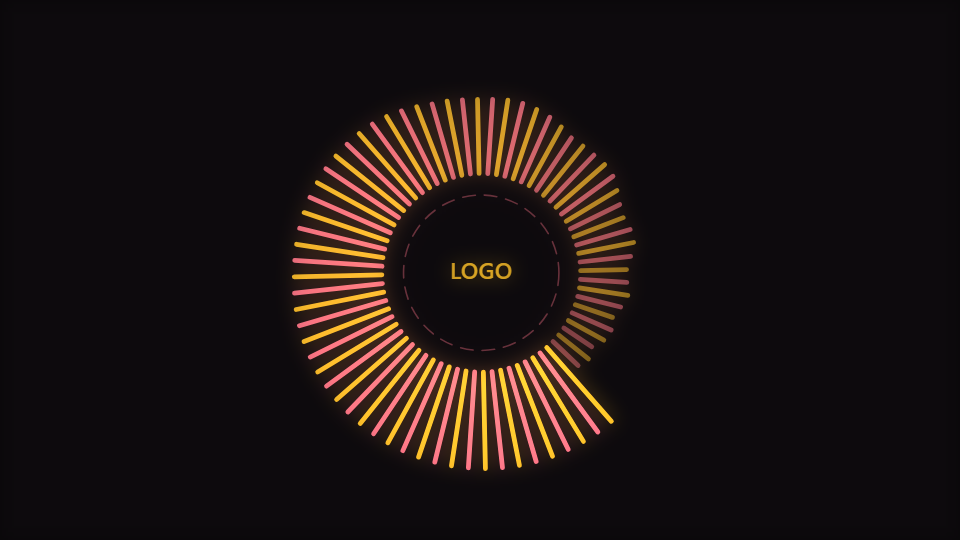
The width you never set
There is no bar width control in this mode. The stroke width is the circumference of the inner ring divided by the bar count, times 0.55, with a floor of 1.2 pixels. In other words each bar takes a fixed 55% of the arc it owns, and the remaining 45% is the gap.
That is the decision. Raise the count and every bar thins automatically, so the ring never fills in; lower it and every bar fattens, so the ring never goes gappy and sparse. Compare the engine-free alternative, which is a fixed width control: at high counts the bars overlap into an opaque annulus and the whole readout is lost, and at low counts you get a handful of thin spokes on a big empty circle. The floor at 1.2 pixels is the one place the derivation stops, and it is what stops a very high count from producing invisible hairlines.
Bars is scoped to this mode alone in the engine, and it ships at 72 inside a branch that bounds it between 8 and 180.
Where each bar's frequency comes from
A bar reads the element band for its position in the ring, which places it on the same logarithmic curve the rest of the catalogue uses rather than on a raw bin index. Around a circle that matters more than it does on a straight field: on a linear mapping, the whole musical content of a track occupies one small arc and the remaining three quarters of the ring is air that barely moves, which looks like a broken visual rather than an accurate one.
A bar's outer end is its inner radius plus a fixed floor, plus its band, plus a small onset contribution, all soft-limited against the frame's contain radius. The floor is what gives the ring a visible resting state at silence, which a logo scene needs more than most: the artwork is the subject and the ring is its frame, so the frame cannot disappear between phrases.
Rotation, and the artwork underneath
Rotation ships at 0.1 and is added to every bar's angle, so the whole ring turns as one. Unlike the engine's waveform mode this one takes the full spin rather than a fraction of it, because a ring of discrete bars reads a rotation as motion whereas a continuous curve reads it as drift.
The inner radius is 1.1 times the artwork's safe radius, which itself comes from Logo size, shipped at 0.24. As everywhere in this engine, the artwork is drawn last and the geometry is sized outward from the reserved circle, so no setting can put a bar across your mark.
One shipped value with no panel
This mode ships a default for Audio contribution. The three audio-routing controls are scoped to a single mode in this engine and this is not it, so none of them appears in this panel, and the branch reads its per-bar band and the onset burst rather than any routed level. It is the same pattern that recurs across the catalogue: a default value is a record of intent, not a wire.
When to reach for it
Channel idents, label and artist logos, square social loops, and anything where you want the readout AND the brand in one frame. It is a busier frame than the engine's waveform mode, so it suits energetic material better than ambient. For the calmer alternative around the same artwork, read The Waveform Ring Mode: The Trace Bent Around a Reserved Middle.
Open Orbiting Bars in the gallery or go to the editor.
Reviewed by the editorial team. Report a correction.
Keep reading
Was this page helpful?
Anonymous. Only this page’s address and your yes/no are recorded, and only if you allowed analytics cookies.
Ready to make your own?
Open the editor, drop in a track, and export a watermark-free video: free, no account.
Open the Editor