The Center Mirror Mode: Half the Headroom, Both Ways
Center Mirror grows bars in two directions from the middle of the frame, which halves the room each one has. Here is the budget that fixed it, and the gloss that brightens bars without lying about their height.
Center Mirror is the Bars engine mode where bars expand symmetrically above and below center. It is the mode that caught a containment bug the rest of the engine could not, for a reason that is obvious once stated.
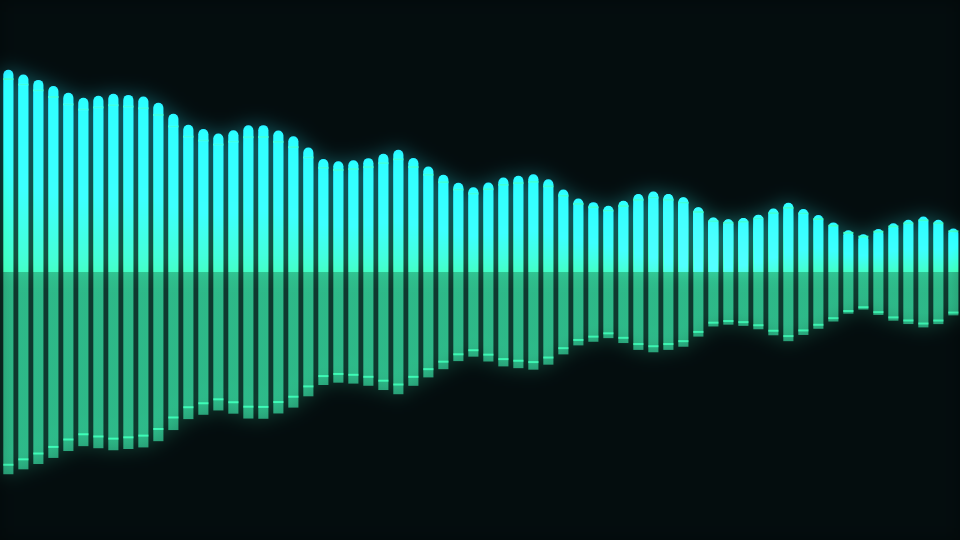
Half the room, twice over
A bottom-anchored equalizer has the whole frame height to grow into, and the engine deliberately lets those bars sit flush on the frame edge because that is what the reference look is. This mode starts from the middle and grows both ways, so the available room is the smaller of the distance up to the top of the frame box and the distance down to the bottom of it.
That distinction had to become explicit in the code. Bar height combines the Bar height control, a multiplier from the beat pulse, and a value that already carries onset headroom. On this mode those three put the tips a quarter of the frame height above the top edge, while the bar looked correctly sized at rest, which is the classic shape of a containment defect: right until the music is loud.
It is not a clamp
The height passes through the same soft-knee limiter the rest of the catalogue uses. Below about sixty per cent of the budget it is the identity, so ordinary levels are untouched; above that it compresses smoothly and approaches the limit without reaching it. Louder always reads as taller, at every level.
The mirror is a rectangle, and that is visible
The upper half of each bar is drawn with the cap shape you selected, which for the default rounds the two top corners while keeping the base flush on the baseline. The mirrored half below is a plain rectangle at reduced opacity, and its opacity rises with the beat.
So Cap shape reads on the top half only. That is not an oversight to work around; it is what makes the two halves distinguishable, and it is why the mode still reads as a reflection rather than as a single tall bar centred on the line. Peak-hold markers, by contrast, are drawn on both sides.
The sweep that does not lie
Bars had no time-based motion at all, which meant the engine offered a Speed control that did nothing in any of its modes. The fix had to be something an equalizer can carry without misrepresenting the audio, and there is exactly one such thing: a highlight that travels across the field, lighting bars in turn without changing any bar's height.
So a gloss sweeps across the field on the motion clock, composited additively over each bar that has already been drawn at its true height. The distance to the sweep is measured wrapped, so the highlight is continuous across the seam instead of restarting at the left edge. Turn Speed to zero and the sweep stops; nothing else about the readout changes.
Audio shaping, and one quiet fix
Bar values are not raw spectrum. They pass through the engine's shaping stage, which applies Sensitivity and the attack and release ballistics, so a bar rises and falls on a real envelope rather than snapping to whatever the analyser reported this frame. Peak hold then tracks each bar's recent maximum, and the marker fades across its hold so the duration is visible from the first frame. This mode ships a hold of 420 milliseconds and a bar height of 0.42.
One detail that is invisible until it is wrong: the engine preserves the incoming canvas opacity through every highlight, mirror and marker it draws. Resetting it to fully opaque made the Opacity control byte-identical in every mode of this engine, which is a control that appears to work and does not.
When to reach for it
Anything that wants an equalizer but not a floor. It is the natural choice for a vertical or square crop, because a centred composition wastes less of the frame than a bottom-anchored one, and for an overlay over footage, where a bar sitting on the bottom edge would look like a bug.
Open Center Mirror or the editor. For the same engine wrapped around a circle instead, read The Radial Bars Mode: The Only Contained Layout in Bars.
Reviewed by the editorial team. Report a correction.
Keep reading
Was this page helpful?
Anonymous. Only this page’s address and your yes/no are recorded, and only if you allowed analytics cookies.
Ready to make your own?
Open the editor, drop in a track, and export a watermark-free video: free, no account.
Open the Editor