The Constellation Mode: Sparse on Purpose
Constellation ships a fraction of the particles the other modes do, and that is the design. Here is why the links only read as a constellation while the nodes stay countable.
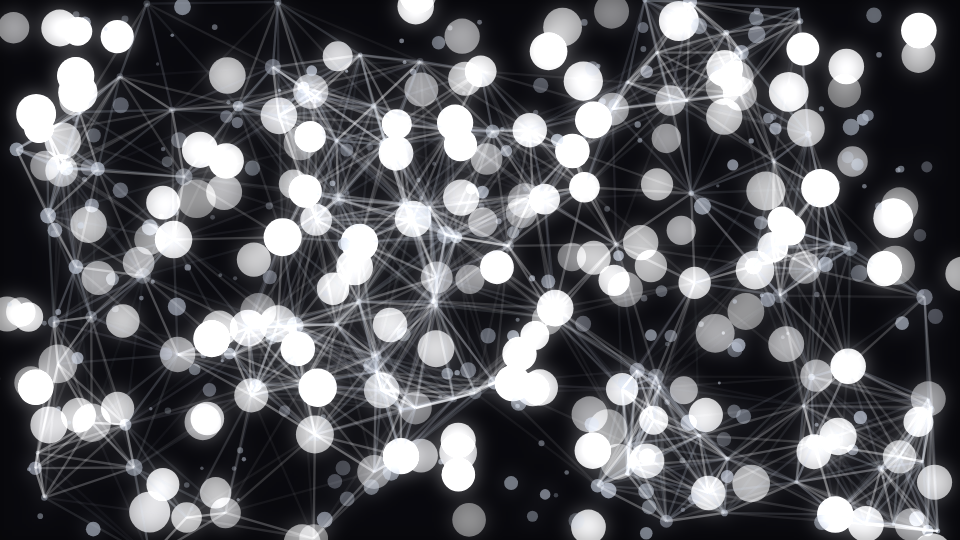
Constellation is the mode in the Particles engine that draws lines as well as points: sparse linked nodes that breathe with mid frequencies. It is also the only one that ships a deliberately low particle count, and the two facts are the same fact.
The link pass, and what it costs
After every particle is drawn, the mode walks the list of on-screen positions and tests each pair. Two points are joined when they are closer than a threshold derived from the Connection distance control and the shorter side of the frame, and the link is drawn at an opacity that falls off linearly to nothing exactly at the threshold, so a connection appears and disappears by fading rather than by popping.
That pairwise walk is quadratic, which is why it is capped. Only the first 140 drawn positions are eligible for linking, whatever the particle count is set to. Raise the count and you get more unlinked dots, not a denser web. This is the single most useful thing to know about the mode, because it explains a result that otherwise looks like a bug: turning the population up makes the constellation look less like a constellation.
Tune the threshold, not the population
Connection distance is the control that changes the topology. Low values give you isolated pairs and triangles; high values give you a mesh where every eligible node reaches every other and the structure stops reading. The default sits deliberately in the middle, and this mode ships it higher than the engine default because its nodes are further apart.
What the beat does to a link
Two things, both bounded. The beat pulse widens the threshold slightly, so more pairs qualify on a hit and the web momentarily knits itself together. It also raises the link opacity and the line width. Nothing here is switched by the beat latch: the structure breathes rather than flashing, which is the opposite choice from the geometric engines where a beat decides whether an element exists at all.
Individual nodes still respond on their own. Every particle in this engine reads a band chosen by the size bucket it was seeded into, so small, medium and large nodes can be bound to different parts of the spectrum through the particle-layer panel. The result is a network where the lows and the highs move different nodes, which is what stops it looking like one object being scaled.
Its own motion
Nodes do not travel. The branch for this mode adds a small sine and cosine offset around each point's seeded position, with Turbulence widening the horizontal wander and Gravity the vertical one, plus a fixed contribution from Direction X and Direction Y. It is a breathing field, not a moving one, which is exactly what a constellation should do: a network that drifts across the frame stops being a shape and starts being traffic.
The mode ships 400 particles and a particle size of 1.6, which is well above the engine default. Fewer, larger nodes is the entire recipe.
When to reach for it
Ambient, downtempo, lo-fi, podcast and spoken-word beds, and anything where the visual is supporting text rather than competing with it. It is one of the calmest scenes in a catalogue of 23 engines, and it survives being cropped to a vertical frame better than most because its composition is a distribution rather than a centred object.
It is the wrong choice when you want the picture to land on a kick. For that, the same engine's beat-emitted arcs or a geometric engine will serve you better. Open Constellation in the gallery or start editing at the editor deep link, and read The Starfield Mode: Why Depth Has to Reach the Sprite for the mode at the opposite end of the same engine.
Reviewed by the editorial team. Report a correction.
Keep reading
Was this page helpful?
Anonymous. Only this page’s address and your yes/no are recorded, and only if you allowed analytics cookies.
Ready to make your own?
Open the editor, drop in a track, and export a watermark-free video: free, no account.
Open the Editor