The Corridor Grid Mode: Rings Alone Are Not a Corridor
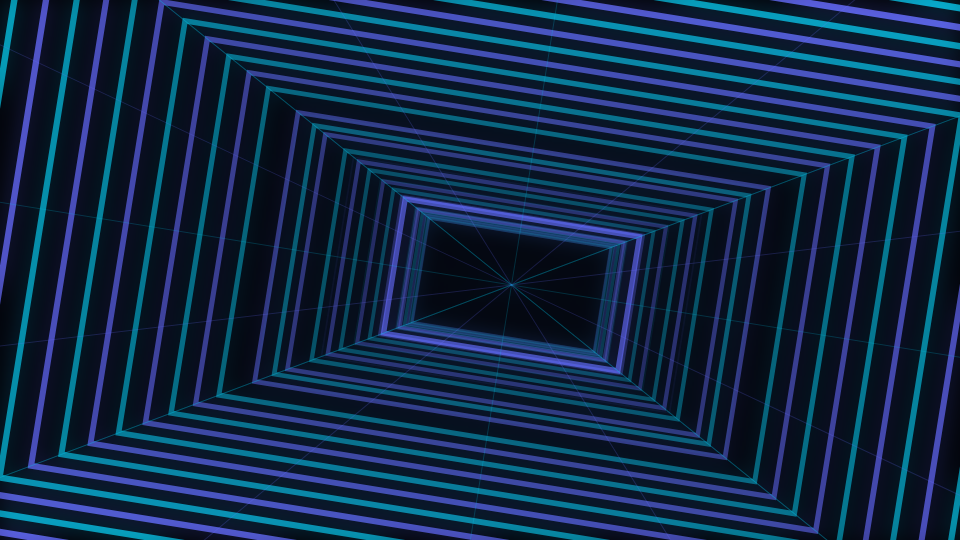
Corridor Grid adds twenty lines that nothing else in the engine draws. Without them a corridor is a stack of nested rectangles; with them it is a surface running away from you.
Corridor Grid is the Tunnel engine at its most architectural: walls and floor form a measured perspective corridor. It shares the engine's ring machinery with four other modes and then adds one pass that none of them has, which is the whole reason it reads as a room rather than as a target.
The twenty lines
After the rings are drawn, this mode walks the perimeter of the NEAREST ring in four segments, takes five points along each, and strokes a line from every one of them to the vanishing point at the centre. Twenty lines, one pixel wide, at about a tenth opacity with a small lift on the beat.
That is a small amount of ink for a large amount of read. Rings alone give you depth SPACING but nothing continuous between them, so the eye assembles them as a set of separate shapes at different sizes. The longitudinal lines are what turns the same rings into walls, a floor and a ceiling. They are drawn under the nearest ring's rotation, so a twist setting carries them with the corridor rather than leaving them behind.
The cross-section is not a choice here
Every other ring mode in the engine asks the Cross section control what shape to draw. This branch does not: it forces a rectangle whatever that value says, and the control is correspondingly scoped out of this mode's panel. Interestingly, the mode still SHIPS a cross-section default. That value records the intent of the design rather than doing any work, which is the trap worth carrying away from this engine: a default in the catalogue is not proof that anything reads it.
A ring carries the moment it was born
The engine's central idea is shared with this mode rather than invented by it, and it is worth stating because it explains the whole look. A ring's identity is its slot plus which trip around the loop it is on. When a slot wraps to the far end, it becomes a new ring and freezes 24 bands of the CURRENT spectrum. From then on it renders its own snapshot as it advances toward you. The corridor is therefore a scrolling record of the last few seconds of the track, not four rings all pulsing to the same live frame.
Travel is strictly monotonic for the same reason: it is driven by the motion clock alone with no bass term added. A travel value that wobbled would re-trigger births every time the bass jittered across a boundary, and no snapshot would ever hold. The beat rush is not lost, because the motion clock already accelerates on beats while staying strictly increasing.
Depth, field of view and how big the corridor is
Segments ships at 36 and is capped at 96 in the branch. Field of view is clamped between 15 and 140 degrees and normalised against 58, so it widens or narrows the whole corridor without deciding whether it fits. And the near ring's size is SOLVED from a target of 1.12 times the canvas width rather than hard-coded, so it is always in the act of passing you whatever the depth setting is. The previous fixed constants put the nearest ring at roughly 38% of canvas width, which reads as a small motif in the middle of the screen rather than something you are flying through.
Routing controls, and the one mode that has them
This mode ships a value for Audio contribution, but the three audio-routing controls are scoped to a single mode in this engine and this is not it. Everything here comes from each ring's own frozen spectrum, the beat pulse and the onset burst. Speed, by contrast, is NOT scoped away, so it applies to every mode in the engine including this one, through the motion clock that travel is built from.
When to reach for it
Techno, trance, drum and bass, trailers, and anything that wants relentless forward motion with structure around the viewer rather than past them. It also holds centred text better than most immersive scenes, because the middle of the frame is where the rings are smallest and dimmest. For the same engine with a live cross-section instead of a frozen one, read The Waveform Tube Mode; for the engine's other outlier branch, The Particle Vortex Mode: The One Tunnel Branch That Does Not Return.
Open Corridor Grid in the gallery or go to the editor.
Reviewed by the editorial team. Report a correction.
Keep reading
Was this page helpful?
Anonymous. Only this page’s address and your yes/no are recorded, and only if you allowed analytics cookies.
Ready to make your own?
Open the editor, drop in a track, and export a watermark-free video: free, no account.
Open the Editor