The Particle Vortex Mode: The One Tunnel Branch That Does Not Return
Particle Vortex is the only mode in its engine that renders two passes in one frame: a spiral of particles, and then the same ring corridor everything else draws. They travel in opposite directions.
The catalogue says Particle Vortex is where particles spiral through a shared camera-space vortex. True, and incomplete. Every other branch in the Tunnel engine either draws rings or draws streaks and returns. This one draws its particles and then falls through into the shared ring loop as well, so a single frame contains both.
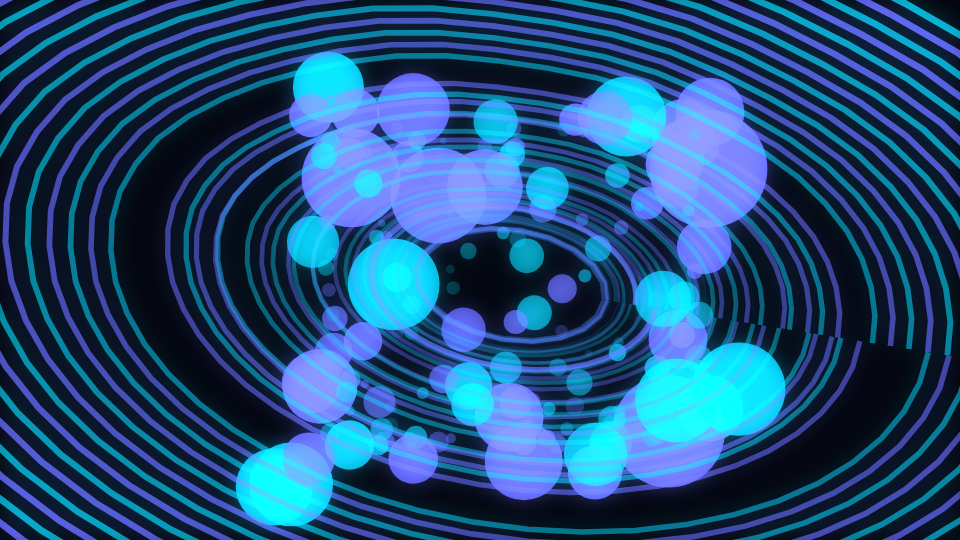
Two passes, two directions
The two passes share a travel value and read it with opposite conventions. In the particle pass, a particle at the start of its cycle is the near one: largest, brightest, furthest from the centre. As travel advances it shrinks, dims and drifts inward. In the ring pass, the start of the cycle is the FAR end: a ring is born small and faint at the vanishing point and grows toward you until it passes the frame edge.
So the particles spiral away from you into the middle while the rings rush out past you. That is not a bug and it is not obvious from any control; it is a property of the two branches having been written against different depth conventions, and it is a large part of why this mode feels busier than anything else in its engine.
What makes the spiral a spiral
Each particle's angle is its own seeded phase plus a slow wall-clock term plus twice the motion clock, plus half the raw bass band. That last term is the one worth noticing: this is the only path in the engine where the bass band directly rotates the geometry, so a kick does not merely brighten the vortex, it twists it. The particle's horizontal and vertical seeds are then folded in as further per-particle angular offsets, so the points do not lie on one clean spiral arm but on a family of them.
The vertical extent is scaled to 85% of the horizontal, which gives the vortex a slightly flattened profile and stops it reading as a flat disc seen face on. Particle count comes from the shared quality budget with a ceiling of 600. The number you set is a target, not a promise. It is scaled by the preview scale, by the canvas area relative to 1080p, and by a further reduction on machines reporting four or fewer cores, then capped. Export with capture quality on and the last two of those are switched off, so the exported frame is the count you asked for.
The only tunnel mode with routed audio
Audio contribution and the source and dynamics controls beside it are scoped to this mode ALONE in the engine, and this mode ships an amount of 0.88. That is not an accident of the table: the particle pass reads the routed per-element level into each particle's size, so the routing genuinely reaches the canvas here and nowhere else in the engine. It is the clearest example in the catalogue of scoping that reflects the code rather than describing it.
And one shipped value with nowhere to go
The same mode ships a default for turbulence. The turbulence control belongs to two engines in the catalogue and Tunnel is not one of them, so it never appears in any panel here, and the string "turbulence" does not occur anywhere in the engine's draw module. It is a number with no reader.
Particles you can shape
Geometry is scoped to this mode alone in the engine, because it is the only one that stamps particles rather than stroking paths. The shared stamping routine understands squares, rounded rectangles, triangles, stars, ellipses, short line segments and a soft radial glow as well as the default circle, so the same spiral can read as sparks, as confetti or as a smear of light without touching anything else.
The mode ships a Cross section of circle, and unlike the engine's corridor mode this one does read it: the rings behind the particles are built from that shape, at 48 sides, with a level-of-detail reduction to 20 for rings that are still far away and only a few pixels across.
When to reach for it
Bass-led electronic music, psytrance, dubstep, and anything where you want the geometry itself to respond to the low end rather than just flash with it. It is the busiest mode in its engine, so give it space: it does not sit behind dense text well. For the structural opposite, read The Corridor Grid Mode: Rings Alone Are Not a Corridor; for the engine's speed-first mode, The Warp Field Mode.
Open Particle Vortex in the gallery or go to the editor.
Reviewed by the editorial team. Report a correction.
Keep reading
Was this page helpful?
Anonymous. Only this page’s address and your yes/no are recorded, and only if you allowed analytics cookies.
Ready to make your own?
Open the editor, drop in a track, and export a watermark-free video: free, no account.
Open the Editor