The Warp Field Mode: A Streak Carries the Beat It Was Born On
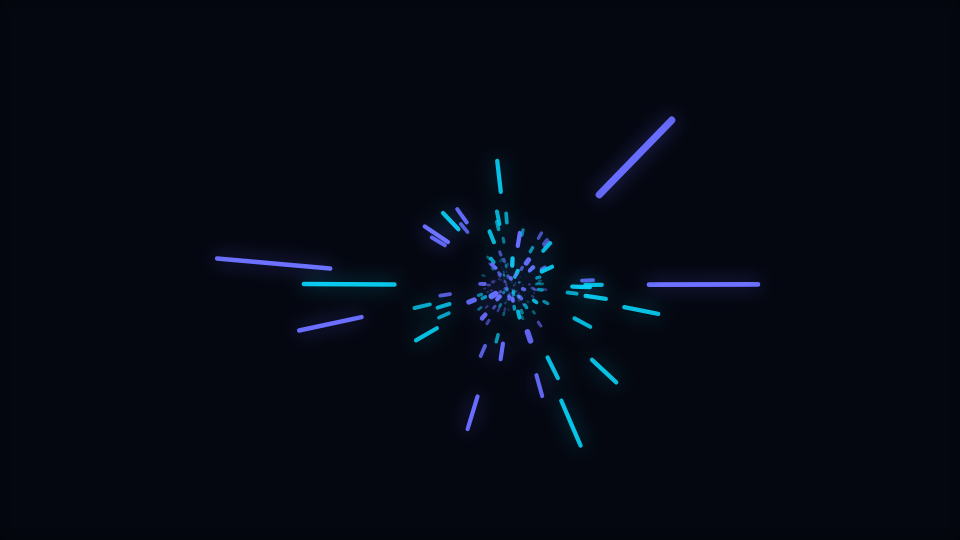
Warp Field draws streaks rather than rings, because a ring is the same shape however fast it travels. Each streak also remembers whether it was born on a beat, and keeps that mark all the way in.
Warp Field is the odd one out in the Tunnel engine: a point field accelerates visually while velocity stays bounded. Five of the six modes there draw rings receding down a corridor. This one draws no rings at all.
A ring cannot convey velocity
This is the observation the mode is built on. A ring travelling toward you at any speed is the same shape on every frame; only its size changes between frames, and the eye reads that as scale, not as velocity. Motion blur is what communicates speed, and the cheapest honest version of motion blur is to draw the path a point took during the frame.
So each element here is a line from where its point was at the start of the frame to where it is now, both projected through the same perspective. When the field is slow the streaks are short and it reads as a starfield; when it is fast they stretch and it reads as a jump to light speed. Nothing else in the mode changes.
A streak remembers the beat it was born on
This branch originally read only the continuous beat envelope, which eases up and down. Nothing in it responded to the discrete latch, so the mode drifted while every other mode in the engine hit.
It now uses the same scheme the ring modes use. Each streak's trip through the corridor is numbered, and when that number changes the streak has recycled to the far end. If it recycled on a frame where a beat latched, it is marked, and it keeps the mark for its whole trip. The field therefore carries a visible cohort of bright streaks per beat, spaced by tempo, instead of one global flash that is gone on the next frame.
The first frame is excluded on purpose
On the very first frame every streak is unborn and would otherwise latch together. If that frame happened to land on a beat, the entire field would be marked at once and stay marked for a full trip. A streak that has never travelled is not eligible to be an accent.
A marked streak gets three things: a distinct palette colour, extra brightness, and extra length, because the per-frame step is lengthened by the onset burst on marked streaks only. That last one is what reads as the field lurching forward on the hit rather than merely flashing.
Why travel has to be monotonic
Birth is detected by an integer crossing, which means the travel value must only ever increase. Add a bass term to it, as an earlier version did, and the value wobbles across boundaries whenever the low end jitters, re-triggering births several times a second and preventing anything from being carried at all.
The beat rush is not lost by removing it. The engine's motion clock already integrates speed multiplied by the beat pulse, so it accelerates on beats while remaining strictly increasing. That one property is what lets every mode in this engine carry state down the corridor.
Controls, and the ones that stop at the door
- Speed is the primary control, and this mode ships it at 0.38, the highest in the engine. It sets both how fast points travel and, through that, how long the streaks are.
- Depth stretches the corridor, which changes how quickly a point crosses from far to near.
- Fog fades far streaks toward the background. At zero the field is uniformly bright and the depth cue weakens considerably.
- Camera path drifts the vanishing point around the frame on a slow cycle, which is the difference between flying and being flown.
- Colour mode applies to unmarked streaks; marked ones take a fixed palette slot so the accent stays legible whatever the palette is doing.
Cross section, Segments, Twist, Field of view, Surface deformation and Rotation all belong to the ring path and are scoped away from this mode in the catalogue. The mode returns before any of them is read.
When to reach for it
Hard dance, trance, drum and bass, trailers, and any drop that wants the frame to move. It is the most GPU-weighted engine in the catalogue, with a published budget of 48 elements by default and 28 on mobile, so check the preview on a phone before committing to a long export.
Open Warp Field or the editor. For the mode in the same engine whose surface is the current audio rather than a stored snapshot, read The Waveform Tube Mode: The Corridor That Reads Live.
Reviewed by the editorial team. Report a correction.
Keep reading
Was this page helpful?
Anonymous. Only this page’s address and your yes/no are recorded, and only if you allowed analytics cookies.
Ready to make your own?
Open the editor, drop in a track, and export a watermark-free video: free, no account.
Open the Editor