The Lattice Engine: Geometry That Switches on the Beat
Kaleidoscopes, hex tilings, wireframe solids, isometric grids, trusses and expanding prisms. Lattice is the engine where an element is lit or it is not, which is what makes it read on the beat.
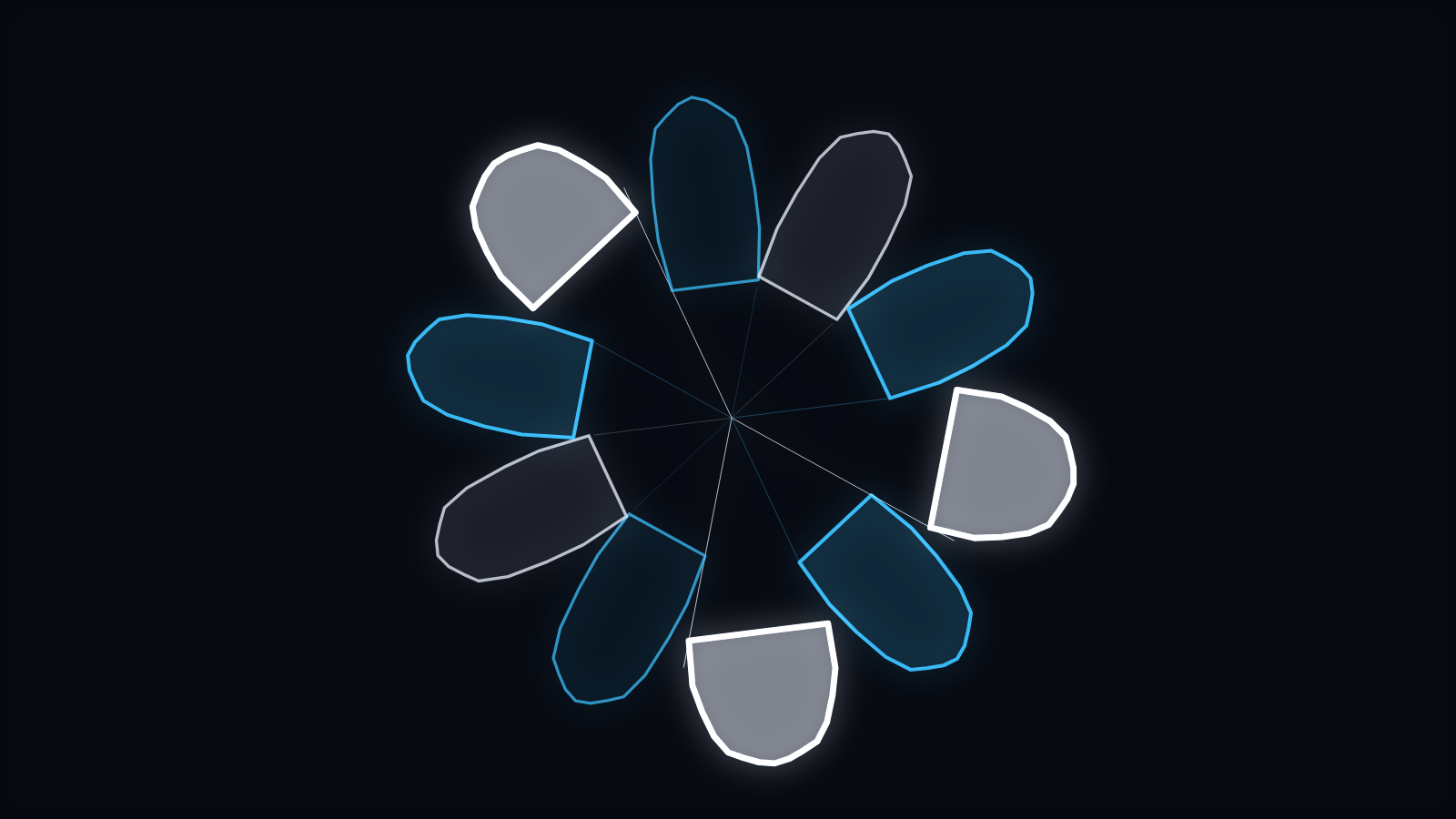
Lattice is the catalog's geometry engine: mirrors, tilings, wireframes and trusses: hard-edged geometry that switches on the beat. It ships 6 modes and it is the one engine where the picture changes on a beat instead of only getting brighter on one.
Why discrete geometry behaves differently
Radial is also anchored at the center of the frame, and the two engines are easy to confuse from a thumbnail. The difference is in what an element is. Radial draws continuous structures: rays and rings whose length varies smoothly with a frequency band. Everything in Lattice is discrete and structural. A tile is lit or it is not. A strut is carrying current or it is not.
That distinction has a direct musical consequence. A continuous element can only be swelled by an envelope, so a kick makes it a bit bigger. A discrete element can be switched by a beat latch, so a kick makes it exist. Every mode here drives at least one property from the beat rather than from the smoothed audio level alone, which is why Lattice reads as rhythmic on material where a spectrum bar would just wobble.
The six modes, and what each one does on a hit
- Kaleidoscope authors one wedge and mirrors it around the frame. The wedge profile is cut from the spectrum, so the mirror lines carry real frequency content. It is drawn from a handful of straight chords rather than a smooth spline, deliberately: a curve mirrored around a center draws petals, which is Bloom's job. A kaleidoscope is made of facets, and each wedge ignites in groups as beats land.
- Tessellation is a hex tiling whose tiles never move. Only their fill changes, and a beat lights one diagonal stripe of tiles which advances by one column on the next beat, so the pattern travels across the grid instead of flashing all at once.
- Wire Polyhedron places vertices on a Fibonacci sphere and wires up every pair closer than a threshold. The vertex count is a control rather than a fixed solid, so the same mode covers something close to a tetrahedron and something close to a geodesic dome.
- Isometric Grid raises a block per cell, with the height of each column taken from its frequency band, read as a city skyline from a fixed camera. Beats ignite cells in three interleaved groups.
- Truss Web builds concentric node rings and wires each node to its neighbours. The strut is the element here, charged in five groups so current appears to travel through the structure.
- Prism Stack is the most literal: one polygon is born on each beat latch and travels outward carrying that hit. A quiet passage produces an empty frame, because no beat means no prism.
Hear the engine by muting the beat
Drop Beat response low and most Lattice modes lose the thing that makes them Lattice. That is the fastest way to feel what the beat latch is doing, and the fastest way to diagnose a scene that has gone flat: it is almost always the beat path, not the spectrum.
Controls that matter most here
Lattice shares the catalog's common controls, and three of the engine-specific ones do most of the work:
- Sides sets the polygon used by the tiling and the truss ring geometry. Six gives you a classic hex tiling; raising it walks the tiles toward circles.
- Cells is the grid density, and it is the single biggest lever on how busy the frame looks. Tessellation reads it as columns; Isometric Grid clamps it into a square grid; Truss Web derives its ring count from it.
- Symmetry is Kaleidoscope's wedge count, and it is the control that turns one scene into a completely different one. Low values read as a folded poster; high values read as a mandala.
Alongside those, Cell fill decides whether you get a wireframe or a solid, and Lattice jitter adds controlled irregularity to the truss so the structure looks built rather than generated. The Lattice engine reference publishes the live control table, its render load and its element budget: a default of 120 with 56 on mobile, which is the honest ceiling rather than a marketing number.
Containment, and why the tiling is clipped
A tiling covers the frame by definition, which means its outermost tiles are always partly off-screen, and their radius, stroke width and fill all rise with the audio. Measured against the catalog's containment budget, that produced a burst of border ink appearing only on peaks. Tessellation is therefore clipped to the frame box: the tiling still spans everything it is supposed to, and the margin the rest of the catalog respects stays clear at every level.
It is worth knowing because it changes how you frame text. The safe zone holds on this engine even at full reactivity, so a title placed with the frame margin in mind will not be eaten by a drop. Framing Your Visual has the general rules.
What Lattice is good for
Anything with a hard rhythmic grid. Techno, drum and bass, industrial, breakbeat, trap: genres where the kick is an event rather than a swell get the most out of an engine built around events. Kaleidoscope and Tessellation are the two that survive being a background behind text; Prism Stack and Truss Web want to be the whole frame.
For material without a strong transient (ambient pads, solo piano, spoken word) this is the wrong engine, and the fix is not a setting. Reach for Terrain, which reads history rather than hits, or one of the continuous engines.
Open it in the editor with a track you know, start on Kaleidoscope, and cycle the modes without touching anything else. Six drawings of the same beat is a faster education than any amount of parameter tweaking.
Reviewed by the editorial team. Report a correction.
Keep reading
Was this page helpful?
Anonymous. Only this page’s address and your yes/no are recorded, and only if you allowed analytics cookies.
Ready to make your own?
Open the editor, drop in a track, and export a watermark-free video: free, no account.
Open the Editor