The Linear Equalizer Mode: Flush on the Edge, Rounded Only at the Cap
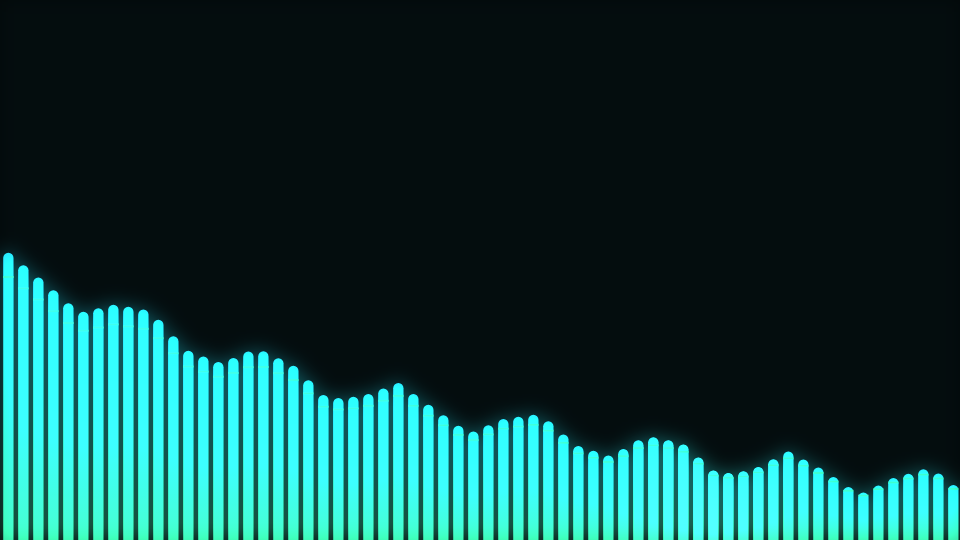
Linear Equalizer sits on the frame edge on purpose, rounds only the two corners at the top of each bar, and runs a gloss across the field that brightens without changing a single bar's height.
Linear Equalizer is the reference look of the Bars engine: a refined baseline equalizer with rounded caps. It is the most familiar shape in the whole catalogue, which is precisely why the details are worth naming. Every one of them is there to make it read as hardware rather than as a chart.
Flush is a decision, not an oversight
Every other engine in the catalogue respects the frame margin: geometry is inset so it does not read as cropped. Bottom-anchored bars deliberately do not. The baseline sits one pixel above the canvas bottom, ignoring the margin entirely, because a row of bars floating above the edge of the frame does not look like an equalizer, it looks like a bar chart that has been positioned badly. The margin still bounds how TALL a bar can be, so the exception is about where the bars start and not about whether they can leave the frame.
Turn Floor reflection up and the floor rises to 82% of the frame height to make room for the mirrored copy below it. That is the one case where the bars come off the edge, and the reason is structural rather than aesthetic.
Rounded at the cap only
At the default Cap shape the bar is drawn as a rounded rectangle with a radius on the top two corners and zero on the bottom two. Rounding all four would lift the bar visually off the baseline and undo the flush anchoring above. The radius is the smaller of half the bar width and 10 pixels, so a narrow bar gets a proportionate cap instead of a stadium shape.
Bar width is not set directly. Bar width is a fraction of the slot, and Bar gap reduces that fraction further, so the two controls compose rather than fight. This mode ships a gap of 0.14 and a Bar count of 64.
The gloss that changes nothing
A highlight travels across the field, driven by the motion clock, lighting bars in turn. It is drawn additively over the bar that has already been painted, re-filling the same path, so it changes a bar's brightness and never its height. That distinction is the whole reason it is allowed to exist: an equalizer is a readout, and a time-based animation that altered the heights would be the visual lying about the audio.
The distance from a bar to the sweep is measured with a wrap, so the highlight is continuous across the seam rather than restarting at the left edge, and it falls off steeply enough that only a narrow band of the field is lit at any moment.
The audio-routing controls are absent from this engine by design
This mode ships a value for Audio contribution, and neither it nor the source and dynamics controls beside it appear in any Bars panel. The reasoning is in the catalogue: Bars is a full-spectrum readout where every bar IS its own band, so selecting one band to drive the whole thing, capping that single route or scaling its dynamics are all meaningless. Sensitivity and the attack and release ballistics ARE wired, and they are the controls that shape its response.
Peak markers that tell you their duration
Peak hold ships at 420 milliseconds. Each marker is a two-pixel bar sitting just above its column's current height, and its opacity decays across the hold rather than switching off at the end of it. Without that decay a short hold and a long one produce identical frames, and the control is only observable by watching one marker until it goes.
When to reach for it
Playlists, radio edits, DJ mixes, podcast clips, and anything where the viewer should be able to read the music at a glance. It survives small players better than almost anything in the catalogue because it is legible at thumbnail size. For the symmetric version anchored at the middle, read The Center Mirror Mode; for the stepped, gridded variant, The Piano/Step Grid Mode: Quantised to Whole Cells.
Open Linear Equalizer in the gallery or go to the editor.
Reviewed by the editorial team. Report a correction.
Keep reading
Was this page helpful?
Anonymous. Only this page’s address and your yes/no are recorded, and only if you allowed analytics cookies.
Ready to make your own?
Open the editor, drop in a track, and export a watermark-free video: free, no account.
Open the Editor