The Frequency Ridge Mode: Only the Front Row Is a Ridge
Frequency Ridge strokes its front row at more than double the width of every row behind it, fills only the first six, and is the one mode in its engine that reads the noise control.
Frequency Ridge is described in the catalogue as A focused ridge emphasizes bounded band transitions. It is one of four modes in the Spectrum engine that draw the past as well as the present, and it is the only one that treats the newest row as a different kind of object from the rest.
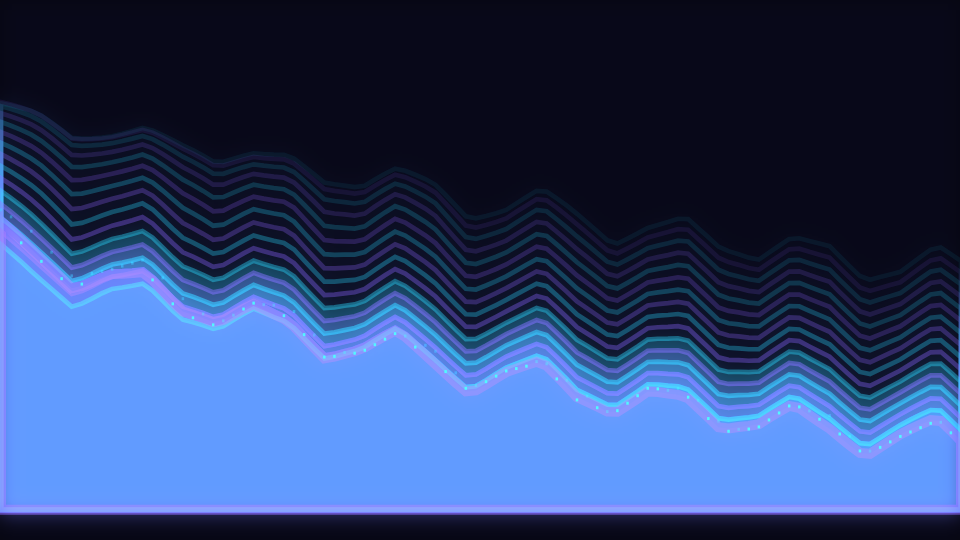
One row in front, the rest behind
The front row is stroked at 3.4 times the configured thickness. Every row behind it gets 1.6. That is not a gradient, it is a two-value split, and it is what produces a ridge rather than a stack: the eye reads the heavy line as the subject and the thin ones as depth. Filling is split the same way, with only the first six rows filled at all, because rows further back are almost entirely occluded by the ones in front of them and filling them is full-width translucent overdraw that nobody sees.
Alpha falls off with depth as well, from just under half at the front to almost nothing at the back, so the ridge fades into the frame instead of ending on a visible last row.
How many rows, and how far apart in time
This mode is capped at 22 drawn rows. That number is a performance boundary and not an arbitrary one: stroking and filling 56 rows at 1080p benched between 20 and 57 milliseconds a frame, which is over the 60fps budget. History SCALES the drawn rows toward that cap rather than merely raising a ceiling that was already lower, which matters because every history mode in the engine ships a depth above its own cap. Reading the control as a simple maximum meant every value at or above the cap rendered identically, and the only way to observe the control was to turn it down.
Speed is a STRIDE here, not a push rate. The history buffer still fills one row per frame; speed decides how many frames apart the drawn rows are. So a slow setting shows the last half second in fine detail and a fast one spans several seconds across the same number of rows. Feeding speed into the push rate instead starves the buffer at low speeds, which is what made the depth control unobservable in the first place.
The exclusive control
Noise deformation is scoped to this mode alone in the engine, and this mode ships it at 0.12. It adds a travelling sine offset along the length of every row, scaled by a small fraction of the frame height. It is deliberately small: the job is to stop the back rows reading as clean copies of the front one, not to turn the spectrum into a wave. Set it high and you will make the readout dishonest, because the wobble is not in the audio.
Smoothing is why it holds together
This mode ships Smoothing at 0.82, which is high. That is a one-pole filter across frames, so consecutive rows differ from each other gently. With smoothing near zero the rows disagree violently and the receding stack reads as static rather than as a surface.
Peaks on top of everything
This mode ships a peak hold of 500 milliseconds, longer than the engine's single-row mode. As there, the value arrives as an authored default rather than as something you can move: Spectrum declares no peak-hold control. Markers are drawn once, after every row, so they sit above the whole stack rather than inside it, and they fade across the hold so the duration is legible from a single frame.
When to reach for it
Anything mid-tempo with a strong melodic line: synthwave, house, film score, lo-fi. It gives you the readout of a spectrum plus the sense of time passing that a single row cannot, without the full commitment of a scrolling heat map. For that heavier option, read The Spectrogram Waterfall Mode; for the single-row version, The Line Spectrum Mode: The Axis Is Logarithmic Because the Bins Are.
Open Frequency Ridge in the gallery or go to the editor.
Reviewed by the editorial team. Report a correction.
Keep reading
Was this page helpful?
Anonymous. Only this page’s address and your yes/no are recorded, and only if you allowed analytics cookies.
Ready to make your own?
Open the editor, drop in a track, and export a watermark-free video: free, no account.
Open the Editor