The Spectrogram Waterfall Mode: Speed Is a Stride, Not a Push Rate
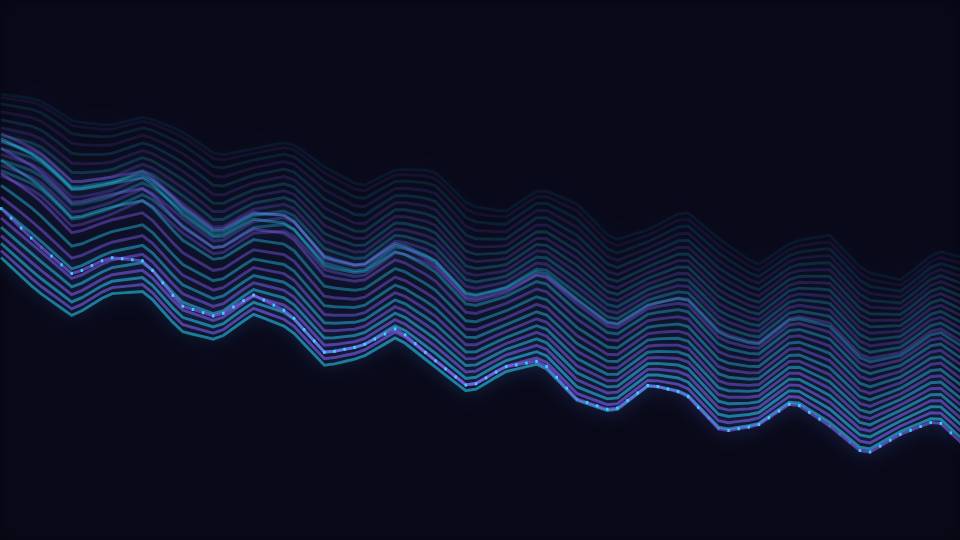
Spectrogram Waterfall draws rows of spectral history receding into the frame. Speed does not change how fast the buffer fills; it changes how far apart in time the drawn rows are.
Spectrogram Waterfall is one of four modes in the Spectrum engine that read history rather than only the current frame: spectral history flows through time without frame-rate coupling. The last three words of that description are the interesting ones.
One row per frame, always
The engine pushes exactly one sampled spectrum row into its history buffer every frame, regardless of any setting. That is the foundation the whole mode stands on, and it is what makes the display frame-rate independent in the way that matters: the buffer always holds the same number of frames, so a scene that looks right in preview looks the same in an export.
What the mode chooses is which of those rows to draw and how many. That choice is two numbers, and getting them the right way round is the difference between a control that works and one that looks broken.
History is a count, Speed is a stride
History scales the number of rows actually drawn. It is divided down and then bounded by a per-mode cap, because a large number of stroked and filled rows is expensive at 1080p and, past a point, indistinguishable. This mode has the most generous cap of the four history modes.
Speed sets the stride: how far apart in the buffer consecutive drawn rows are taken from. At the lowest setting you are looking at the last fraction of a second in fine detail; raise it and the same number of rows spans several seconds. That is why the mode ships a modest speed of 0.1 alongside a large history of 120: a deep buffer sampled finely.
Why Speed is not the push rate
Feeding Speed into how often a row is pushed starves the buffer at low speeds, and then History has nothing to scale: turning one control down silently disables the other. Reading Speed as a stride keeps the buffer full at every setting, so both controls stay live across their whole range.
Depth, and the one limit that governs both
Rows are drawn back to front, each one lifted a little further up the frame than the one in front of it, and each one fainter. Two things are therefore trying to move a point upward at the same time: the sample's own height, and the row's position in the depth ladder.
Limiting those separately is what let the display leave the frame while each half measured as fine. They are added first and limited together against the room between the baseline and the top of the frame box, so the ladder and the swing can never sum past the edge. Soft-limited, not rescaled: dividing by the worst case would shrink ordinary levels to make room for peaks that mostly never come, so the spectrum would read as permanently quiet.
Where the baseline sits
Vertical anchor has three settings and it matters more here than on a single-row mode, because it decides how much room the ladder has. Bottom puts the baseline near the foot of the frame and gives the display the whole height to grow into. Centre halves that but leaves room below. The third setting keeps the older, higher baseline for compositions built around it.
Bins is the horizontal resolution, Smoothing damps the movement between neighbouring bins, and Spectrum range trims the dead top of the frequency axis. That last one is worth a moment: at a 48 kHz sample rate the top of the bin array is near-silent air on most material, so at a range of one the right-hand edge of the display barely moves. The catalogue default trims it, which is why the display uses its full width.
Peak hold, and why it fades
Small markers sit above the front row at each bin's recent maximum and fade across their hold rather than vanishing when it expires. That was a deliberate change: a marker that holds at constant brightness and then disappears makes a short hold and a long one render identically until the moment they end. Fading makes the duration legible from the first frame.
When to reach for it
Electronic and experimental music, sound design, anything technical or analytical, and any video where the point is that the viewer can see the structure of the track. It is the most literal readout in a catalogue of 23 engines, and the engine is rated easy for setup because the defaults already are the look.
Open Spectrogram Waterfall or the editor. For the mode in the same engine built around a reflection rather than history, read The Mirrored Area Mode: A Reflection Has to Be Rebuilt, and for the underlying analysis, How FFT Turns Audio Into Visualizer Bands.
Reviewed by the editorial team. Report a correction.
Keep reading
Was this page helpful?
Anonymous. Only this page’s address and your yes/no are recorded, and only if you allowed analytics cookies.
Ready to make your own?
Open the editor, drop in a track, and export a watermark-free video: free, no account.
Open the Editor