The Mandala Mode: Layered Ray Fans That Count Down
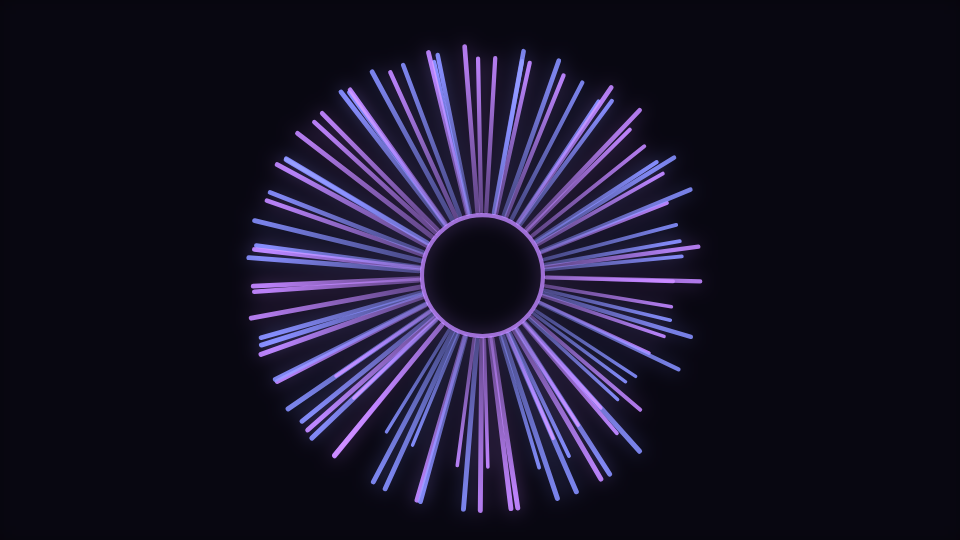
Mandala is not rings at different radii. It is several ray fans stacked in the same annulus, each with fewer rays than the last, counter-rotating and offset by Twist.
Mandala is described in the catalogue as symmetric path repetition forms evolving mandala geometry. The construction is simpler than it looks, and it is not the one most people guess from the still.
Layers, not rings
The obvious reading of a mandala is concentric: a fan of rays at one radius, another fan further out, and so on. That is not what this mode does. Every layer spans the same annulus between the inner radius and the outer radius. What differs from layer to layer is the number of rays, the direction of rotation, and the starting angle.
The ray count is the arithmetic that gives the mode its character. Layer one gets the full symmetry value; layer two gets half of it; layer three a third; and so on, with a floor so a layer never becomes too sparse to read. The layers therefore superimpose a coarse pattern on a fine one in the same space, which is exactly how a drawn mandala is built.
Symmetry has a floor before the mode sees it
The Radial engine raises any Symmetry value below thirty-two up to thirty-two before using it, and caps it well above that. So the divisions start from at least thirty-two rays even though this mode ships a much smaller Symmetry number, and the lower layers hit the per-layer floor rather than thinning indefinitely.
Twist and rotation
Twist is scoped to this mode alone within the engine. It offsets each layer's starting angle by a multiple of the layer index, so it shears the layers against each other rather than turning the whole figure. That is the control that turns a symmetrical star into an interference pattern, and this mode ships it at 0.4.
On top of that, alternate layers counter-rotate on the motion clock, which advances with Speed and accelerates on beats. Two layers turning opposite ways through each other is what makes the figure read as alive when nothing else is changing.
Every ray reads its own band
A ray's length comes from the slice of the spectrum that its position in the fan maps to, on the same curved mapping the rest of the engine uses. That sounds obvious and it was not always true: indexing the bins by the ray number meant a layer with only sixteen rays read the bottom sixth of the spectrum and moved as one lump. Since this mode's inner layers are exactly the sparse ones, it was the mode that caught it.
Ray length passes through the soft limiter rather than a clamp. A clamp would flatten every ray above the limit to the same length, so the loudest passage would be where the mandala stops responding. The soft knee is the identity well below the limit and compresses smoothly above it, so louder always reads as longer.
The reserved middle
Rays start at the inner radius, and the inner radius is whichever is larger of Inner radius and Logo safe zone. A thin accent ring is drawn at that boundary, which frames the reserved area and makes the safe zone visible while you are setting it. If you are planning to drop a logo in, that ring is telling you exactly how much room it has.
Ring count is the layer count and is scoped to this mode and two others. Radial deformation multiplies each ray's response to its band, so it is the reactivity control rather than a shape control. The mode ships 5 layers and a symmetry of 12.
When to reach for it
Psytrance, world and devotional music, meditation content, and any release whose artwork is already symmetric. The engine is rated easy for setup: the defaults are close to a finished look, and Symmetry and Twist are the only two controls most people need to touch. Open Mandala or the editor.
For the simplest mode in the same engine, read The Pulse Orb Mode: A Gradient, a Ray Fan and a Reserved Middle. For a logo in that reserved middle, Make a Logo Visualizer is the practical guide.
Reviewed by the editorial team. Report a correction.
Keep reading
Was this page helpful?
Anonymous. Only this page’s address and your yes/no are recorded, and only if you allowed analytics cookies.
Ready to make your own?
Open the editor, drop in a track, and export a watermark-free video: free, no account.
Open the Editor