The Oscilloscope/Lissajous Mode: A Real Second Channel
Oscilloscope/Lissajous needs two channels to draw a figure, and a delayed copy of the first one will not do. Here is the filter that produces a genuine quadrature partner, and why the figure used to collapse to a line.
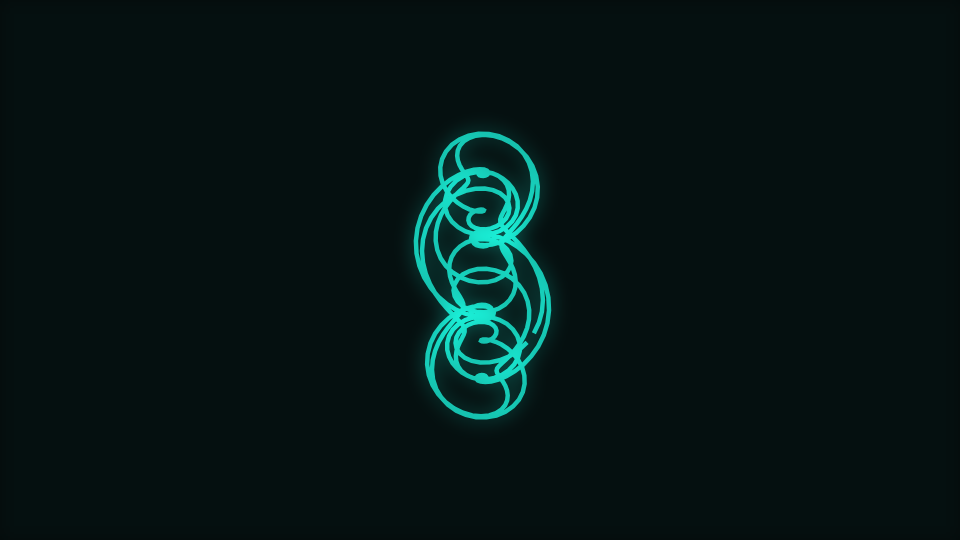
Oscilloscope/Lissajous is the mode in the Waveform engine where stereo channels map to an XY oscilloscope path. It is also the only mode in that engine whose horizontal position is audio-driven: everywhere else, the x axis is just the sample index.
A delay is not a phase shift
The straightforward way to fake a second channel is to read the same buffer at an offset, and this mode used to do exactly that: the same samples, moved along by a quarter of the buffer length. It produced a diagonal line and nothing else.
The reason is that a time delay rotates each frequency by a different angle. A delay of a fixed number of samples is a large fraction of a cycle for a high frequency and a tiny one for a low frequency, and the low-frequency content is what dominates a waveform buffer. So the two channels stayed almost perfectly correlated, and two perfectly correlated signals plotted against each other draw a straight line at forty-five degrees.
What a Hilbert transform does instead
A Hilbert transform shifts every frequency by the same ninety degrees. That is the property the mode needs: it produces the quadrature partner of the signal, which is what a real second oscilloscope channel would give you. A sine then traces a circle, and real programme material traces the looping figures the mode is named for.
The implementation is a short windowed finite-impulse-response filter. The ideal kernel is zero at every even tap and falls off as the reciprocal of the odd ones, so only four coefficients are needed for the taps that matter, taken through a Hamming window over a fifteen-sample span. They are convolved antisymmetrically against the buffer, wrapping at both ends, into a scratch array that is allocated once and reused.
This is mono material, honestly labelled
The partner channel is synthesised from the same signal rather than taken from a second input. That is the right answer here: the analysis path is mono, and inventing a stereo field that the file does not contain would be a nicer picture and a false one. What the figure shows is the phase structure of the signal, which is real.
Phase became a rotation
Phase is scoped to this mode alone, and it now does what a real oscilloscope's phase control does: it rotates the figure. The two channels are combined through a rotation, so the shape turns rigidly rather than distorting. This mode ships it at 1.5708 radians, a quarter turn.
Before that, the control folded the in-phase channel into the vertical axis at a small fixed weight, which made the two axes more correlated the further you pushed it. It flattened the figure it was supposed to be tuning, which is a particularly unhelpful kind of broken control.
Making the trace readable
Two controls exist because a raw trace is unreadable, and they solve different problems. Smoothing averages across neighbouring samples, which removes spatial noise from the shape. Wave window carries a share of the previous frame's buffer into this one, which is the temporal fix: without it every frame draws a fresh, uncorrelated window and the figure teleports rather than moving.
That distinction is worth internalising. If the figure looks jagged, reach for Smoothing. If it looks like it is being redrawn from scratch sixty times a second, reach for Wave window. Spatial smoothing cannot fix a temporal problem however far you push it.
Gain scales both axes, and both are soft-limited independently against the frame box, so a loud passage compresses the figure toward the edges rather than pushing it off them. Speed scrolls the sample window through the buffer, which makes the figure drift through its own shape.
When to reach for it
Electronic music with strong synthesis content, drone, modular and generative work, and anything with a laboratory or analogue-hardware identity. It is a centred, symmetric composition that reads well at any crop. For the vocabulary behind it, the glossary entries on the oscilloscope and on waveform versus spectrum are the shortest route.
Open Oscilloscope/Lissajous or the editor. The same trace bent into a ring around your artwork is Logo territory.
Reviewed by the editorial team. Report a correction.
Keep reading
Was this page helpful?
Anonymous. Only this page’s address and your yes/no are recorded, and only if you allowed analytics cookies.
Ready to make your own?
Open the editor, drop in a track, and export a watermark-free video: free, no account.
Open the Editor