The Par Wall Mode: A Rig With No Beams At All
Par Wall draws no beams and no cones. It is a grid of lamps chasing group by group, and the most interesting thing in it is what the additive blend forced the halo to become.
Novus Team6 min read
Par Wall is the simplest mode in the Stage Lights engine and the one most likely to be underestimated: a back wall of par cans chasing group by group. There is no cone, no throw and no pool of light on a floor. Just the lamps, turning on and off in a pattern.
The grid is derived from the count
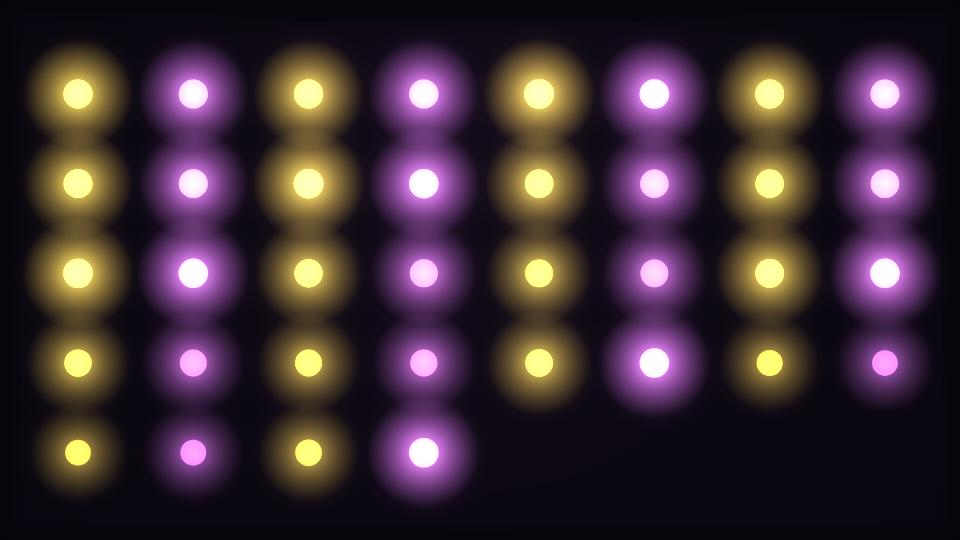
There is no rows or columns control. The mode takes Fixtures, multiplies by 1.8, takes the square root and rounds for the column count, then divides to get the rows. The 1.8 is the landscape bias. At the 36 fixtures this mode ships, that gives eight columns and five rows, which means the last row is partial by construction rather than by accident. A wall of lamps with an incomplete top row reads as a real rig; a perfect rectangle reads as a texture.
Row height divides the frame by the row count plus six tenths, so there is deliberate headroom above the top row rather than lamps flush against the frame edge.
What additive blending did to the halo
The whole engine composites additively, which is right for light and dangerous for a grid. A halo drawn additively does not merely overlap its neighbours, it ACCUMULATES with them: at full scale the outer column's glow reached over one and a half cells and lit the canvas border, which the containment gate measured at nearly three times its budget.
The fix is visible in the geometry. Each halo is soft-limited to its own cell, and the whole wall is clipped to the frame box. So the rig sits on the stage at every level, and a bright passage makes the lamps brighter rather than making the wall bigger. The lamp itself is a small opaque disc at under half the halo radius, which is what gives a par can its hard centre inside a soft glow.
Chase, and a short decay
Fixtures are struck by the beat in rotating groups. This mode ships Chase groups at 6, the highest in the engine, so the wall moves through more distinct states before it repeats. It also ships Fixture decay at 0.28, which is short: a lamp comes up hard and drops away quickly, which is what a chase needs to read as a chase rather than as a slow swell.
Each lamp's brightness also carries its own slice of the spectrum plus the routed level and the onset burst, so a struck lamp in a loud band burns harder than a struck lamp in a quiet one. That is what stops the wall reading as a pure on-off pattern. Haze ships low here at 0.18, because there are no beams for the air to catch.
Four controls that are not in this panel
Speed, rotation, Thickness and Beam spread are all scoped out of this mode, and the branch reads none of them. There is nothing to sweep, nothing to stroke and no cone to widen. A panel that showed them would be four sliders that move and change nothing, which is indistinguishable from four broken ones.
When to reach for it
Live and festival footage, retro and synth material, anything with a strong four-to-the-floor pattern, and any frame where you want energy at the back without geometry competing for attention in the middle. It is unusually good behind a centred logo or title, because its interest is distributed to the edges. For the engine's sharpest mode, read The Laser Sweep Mode: A Stroke, Not a Cone; for the one that tracks a moving target, The Follow Spot Mode.
Open Par Wall in the gallery or go to the editor. The full control table and runtime contract are on the engine reference page.
Reviewed by the editorial team. Report a correction.
Keep reading
Was this page helpful?
Anonymous. Only this page’s address and your yes/no are recorded, and only if you allowed analytics cookies.
Ready to make your own?
Open the editor, drop in a track, and export a watermark-free video: free, no account.
Open the Editor