The Dune Field Mode: The Only Terrain That Never Strokes a Line
Dune Field is the only mode in its engine with no stroke anywhere in its branch, which is why Thickness is scoped out of it and present on all five of its neighbours.
The catalogue is unusually plain about this one: Dune Field gives you wide soft forms for lyric and ambient backgrounds. It is the calm end of the Terrain engine, and it earns that by removing things rather than by adding them.
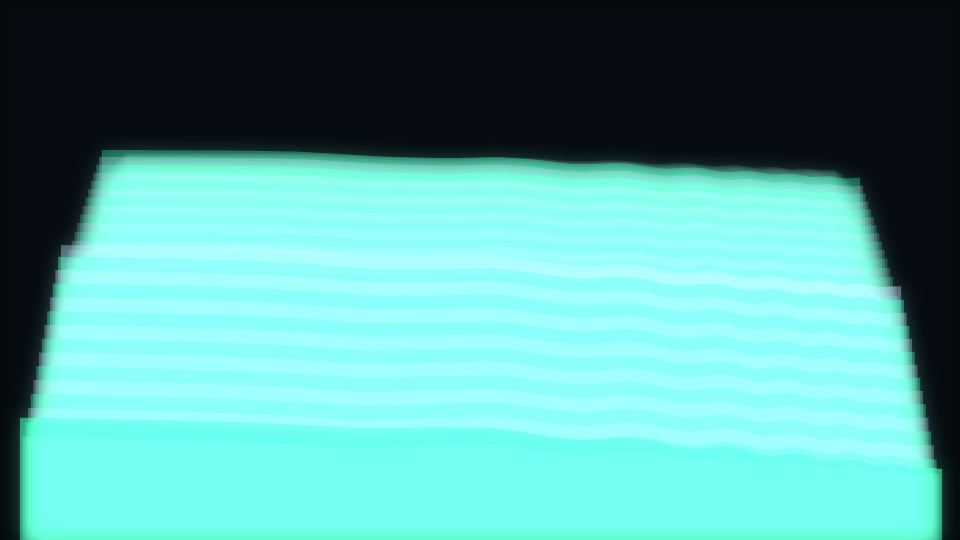
No stroke, anywhere
Every other mode in this engine outlines something. This branch calls no stroke at all: it builds a closed shape per row and fills it. That is why Thickness is scoped out of this mode and present on all five of its neighbours. The scoping table here is not a style rule; it is a description of what the code reads, and a slider that moved with nothing to move would be indistinguishable from a broken one.
Each row's shape is dropped the full height of the frame box below its own baseline before it closes, so a nearer dune covers the one behind it. The fills are still translucent, so the covering builds up colour rather than replacing it, which is what gives a stack of dunes its graded depth without a single outline to separate them.
The smoothing that makes a crest
Before a column's height is used, it is averaged with its two neighbours in a one-two-one weighting and then scaled to 70%. That kernel is what rounds the crest. A spectrum is a jagged thing and drawing it directly gives you a mountain range whatever you do to the colours; averaging across three columns is the cheapest possible low-pass and it is enough to turn a ridge into a dune.
The second half of the softness is Roughness, which this mode ships at 0.05. That control blends between a band's raw level and its square, and at a value this low the profile stays essentially linear in level. Squaring exaggerates peaks relative to the body of the signal, which is exactly what a dune should not do.
Relief ships at 0.4 and History at 40, both a little below the engine's ridge modes. Fewer, shallower rows is the rest of the recipe.
Calm is not deaf
Each row still captures the beat envelope at the moment it is born and carries that lift backwards through the field as it recedes. So a kick is visible here, as a slightly brighter band moving away from you, rather than as a jolt. That is the whole reason this mode can sit under a lyric line without competing with it and still feel connected to the track.
The one control that does more than it looks
Perspective is in scope here, and it changes both the perspective easing that bunches rows toward the horizon and the horizontal inset that narrows each row as it recedes. On a mode with no outlines, that inset is the main cue that the rows are receding at all, so it is worth a pass even though the default is sensible.
When to reach for it
Lyric videos, ambient and downtempo releases, meditation and sleep content, podcast beds, and any scene where type is the subject. It is among the calmest of the 138 modes in the catalogue and it is the one this engine was given specifically so that a landscape could go behind words without fighting them. For the sharper reading of the same field, read The Contour Map Mode: The Terrain That Does Not Hide What Is Behind It, and for text over the top, How to Make a Lyric Video That Actually Syncs.
Open Dune Field in the gallery or go to the editor.
Reviewed by the editorial team. Report a correction.
Keep reading
Was this page helpful?
Anonymous. Only this page’s address and your yes/no are recorded, and only if you allowed analytics cookies.
Ready to make your own?
Open the editor, drop in a track, and export a watermark-free video: free, no account.
Open the Editor