The Canyon Scroll Mode: Containment on a Vertical Offset
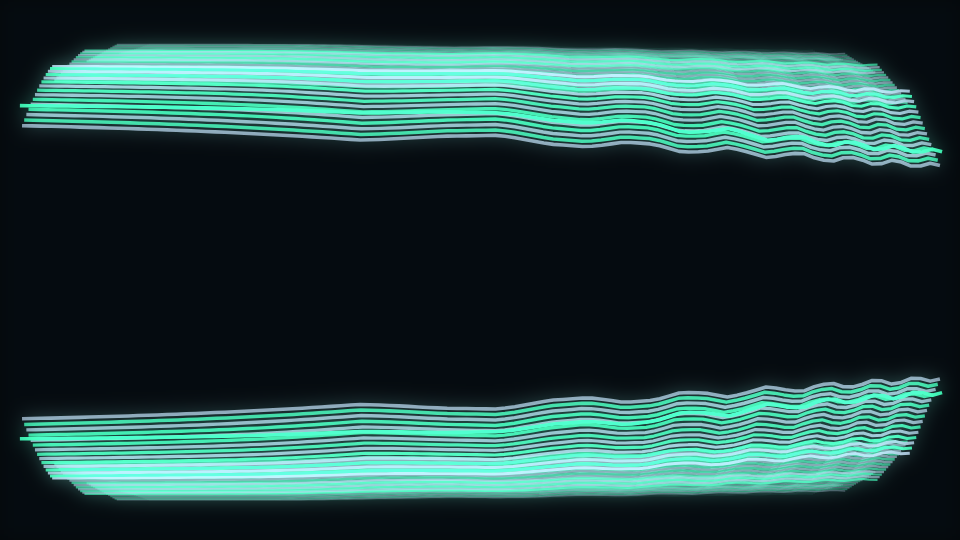
Canyon Scroll mirrors the Terrain heightfield above and below a travelling corridor whose walls already sit on the frame edge at the horizon. That is why its containment rule is not a radius.
Canyon Scroll is the mode in the Terrain engine where the field mirrors above and below a travelling corridor. It is the closest that engine gets to a tunnel, and it is the mode that forced the containment rule there to be rewritten.
What the engine is doing underneath
Every other engine in the catalogue draws this frame. Terrain draws the last few seconds. Each frame pushes one sampled spectrum row into a history buffer, and the buffer is then drawn from back to front, the oldest row at the horizon and the newest at your feet, with rows bunching toward the horizon so parallel lines converge.
A heightfield built purely from band levels drifts with the mix and reads as weather rather than rhythm, so each new row is also lifted by the beat envelope at the moment that row is created. That lift travels backwards through the field with the row, which is the engine's signature: a kick becomes a ridge you can still see receding several seconds later.
The corridor is widest where there is least room
This mode mirrors the field about the centre line and separates the two copies by a gap that grows with distance. The furthest row therefore sits a full half-height from the centre, which is to say exactly on the frame edge. That is the composition working as intended, and it is also a problem: any audio-driven height added to a wall that is already at the edge pushes it straight off the canvas.
Measured on peaks, this produced border ink several times over the engine's budget while the scene looked entirely correct at rest. The fix is the containment rule applied to a vertical offset rather than to a radius: the wall's distance from the centre line is soft-limited against the half-height it is measured from, before it is placed.
Why a radius would have been wrong
Most engines measure containment as a distance from the centre of the frame. A row's height here is an offset from that row's own baseline, and passing a vertical offset through a radial limit is exactly how geometry ends up leaving the frame at the top while still measuring as contained.
The controls that change the land
- Relief is the vertical exaggeration: how tall a given amount of energy makes the walls. It is the first control to reach for when the canyon looks flat or looks like spikes. This mode ships 0.5.
- Perspective controls how hard rows bunch and narrow toward the horizon, and therefore how deep the corridor reads. This mode ships 0.7, higher than the engine default, because a canyon wants a long throw.
- Roughness blends a linear response against a squared one. Low is smooth dunes; high is jagged, because squaring the band exaggerates the loud columns and suppresses the quiet ones.
- History is how many rows the field holds, which is literally how many seconds of the past are on screen. This mode ships 64.
- Horizon sets where the far edge sits in the frame, which is really a composition control: push it up for more room at the top, down to fill the frame with land.
Speed means something unusual on this engine. Terrain has no clock of its own; its only motion is history advancing. Speed therefore sets how many rows are pushed per frame, normalised so the shipped default is exactly one row per frame, and capped low deliberately: each extra push repeats the current spectrum row, so a large value writes several identical rows and the relief flattens into plateaus.
What you are actually looking at
The two walls are strokes, not fills, and both the opacity and the line width of a row rise with how near it is and with the beat lift that row was born carrying. There is no occluding fill pass here, unlike the engine's default mode, because a canyon's far walls are supposed to be visible between the near ones.
The same audio shaping the Bars engine uses is applied to the sampled row before it is stored, so Sensitivity and the attack and release settings shape the landscape the same way they shape an equalizer. The engine's published budget is 96 elements by default and 44 on mobile, which is light for how much is on screen.
When to reach for it
Cinematic, ambient, post-rock, downtempo, and long-form mixes where a viewer is watching for minutes rather than seconds. Because the field keeps showing you the last few seconds, a breakdown reads as calm land rather than an empty screen, which is one of the few scenes that survives a long intro.
Open Canyon Scroll or the editor. The Terrain Engine covers the engine as a whole and the other five ways it draws the same field.
Reviewed by the editorial team. Report a correction.
Keep reading
Was this page helpful?
Anonymous. Only this page’s address and your yes/no are recorded, and only if you allowed analytics cookies.
Ready to make your own?
Open the editor, drop in a track, and export a watermark-free video: free, no account.
Open the Editor